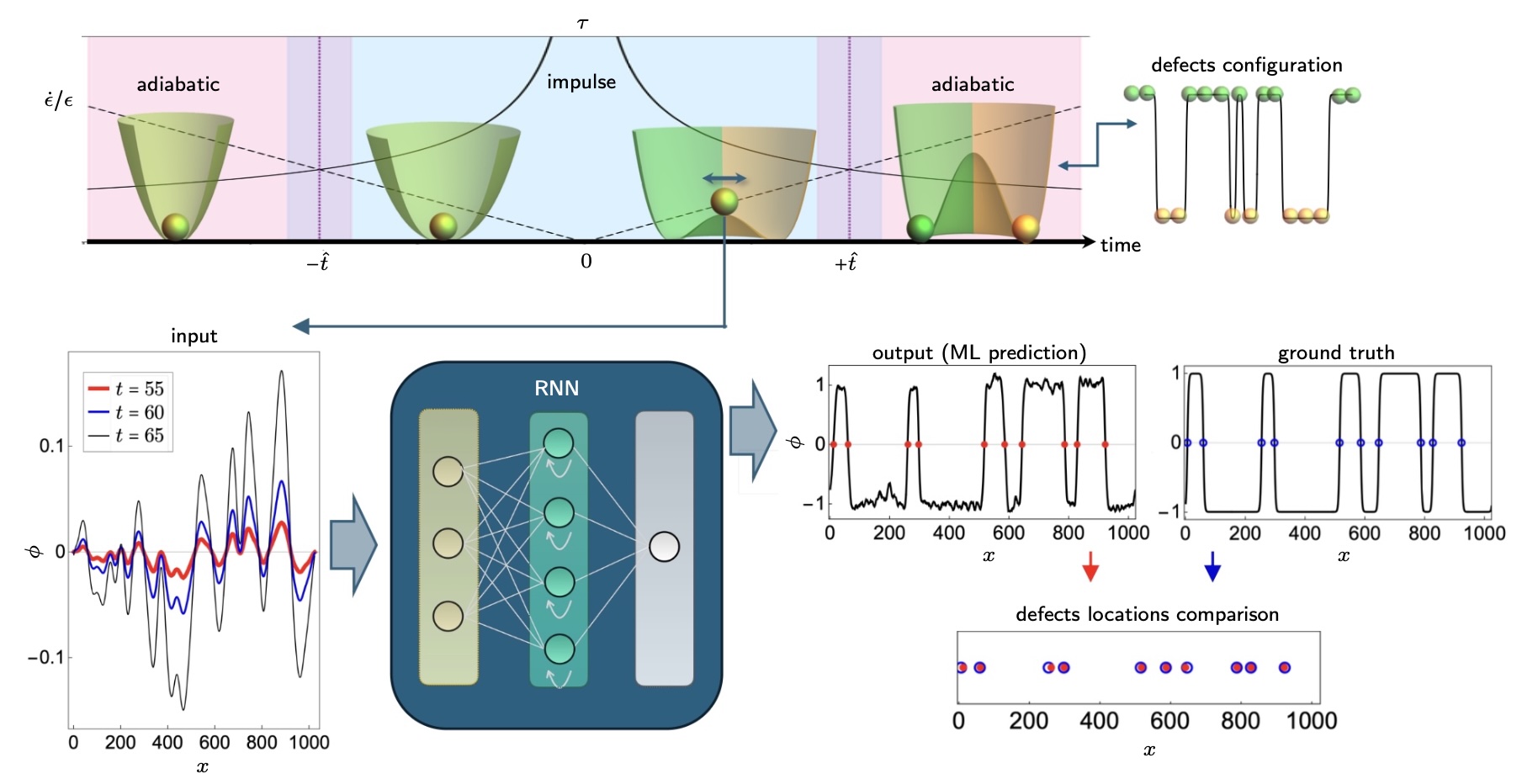
We introduced the fundamental concepts of the Kibble-Zurek mechanism (KZM) to machine learning (ML) for predicting the final configuration of topological defects in second-order phase transitions. It turns out that ML can predict the final configuration based on the time evolution of the order parameter over a short interval in the impulse regime—well before it settles into the new minima resulting from spontaneous symmetry breaking. Furthermore, the predictability of ML follows the power-law scaling dictated by KZM.