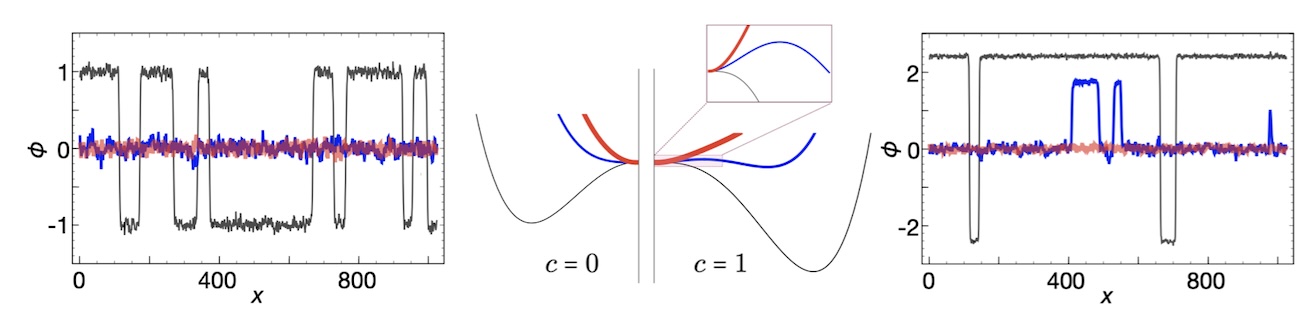
The Kibble-Zurek mechanism (KZM) describes the non-equilibrium dynamics and topological defect formation in systems undergoing second-order phase transitions. KZM has found applications in fields such as cosmology and condensed matter physics. KZM is generally applicable only to second-order phase transitions. However, here we extend the applicability of KZM to first-order phase transitions by combining it with nucleation theory.
*Answers to some common questions:
- We occasionally receive questions referring to theorems derived for equilibrium systems. However, the Kibble-Zurek mechanism addresses "non-equilibrium" dynamics during critical quenches. Please be mindful of the assumptions under which those mathematical theorems were proved.
- Q: Can I use the potential of the form V = φ6 - ε φ2 - c φ4 for a weakly first-order phase transition?
A: Yes, you can. It gives results (of course) very similar to those presented in the paper.